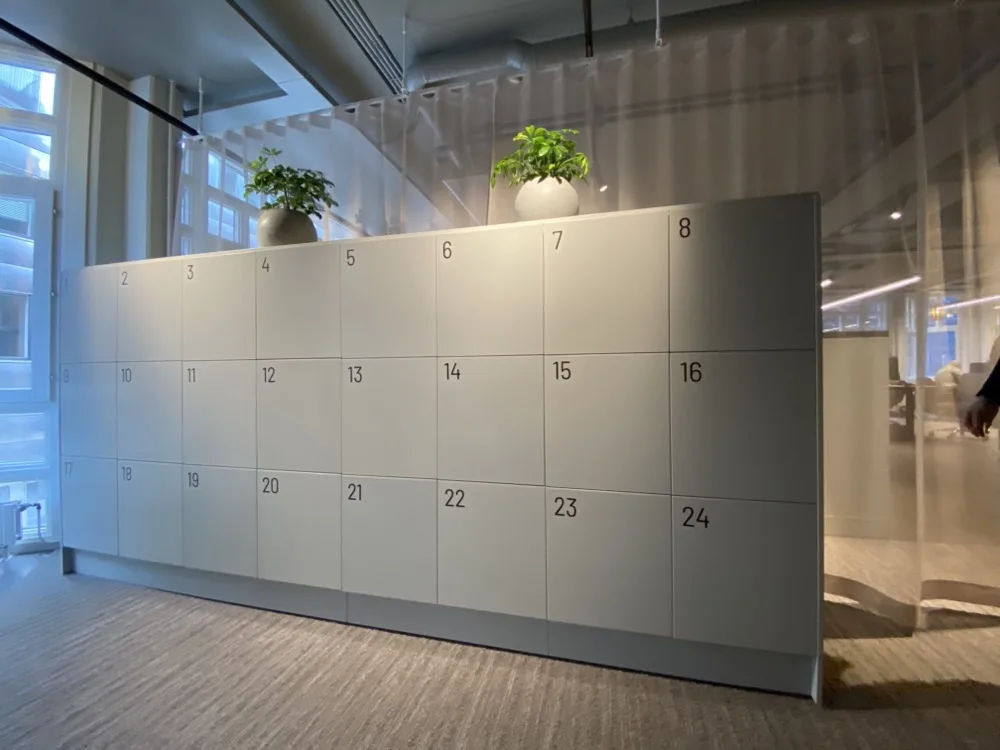
While desks, meeting rooms, and parking spaces have shifted toward flexible allocation, lockers remain the exception. Leaders treat them as furniture that manages itself, so they retain the same permanent-assignment model they’ve used for decades: one locker per employee, managed manually.
In a hybrid workplace with unpredictable attendance patterns, that management model creates three problems:
- Lockers sit empty most of the week while remaining assigned to specific employees
- Hours spent on administrative tasks—lost keys, access updates, onboarding, and offboarding
- Extra costs from provisioning more lockers to serve various purposes (e.g., personal storage, parcels, team equipment, locker rooms) when one flexible system could handle all of them.
However, they often discover that resource waste caused by stale access lists, service desk backlogs, and overcapacity gets worse. It’s all because they retain a management logic that no longer aligns with current hybrid work patterns.
One Employee, One Locker, One Key: Why That Model Broke Down
For decades, locker management was genuinely simple. Stable workforces, single-tenant buildings, and predictable five-day attendance made it rational to assign each employee a locker at onboarding, which they keep until departure.Over time, organisations introduced access cards, while retaining the one-employee-to-one-locker management model.
For a while, that model made sense, as employees always knew a locker was available, and workplace teams could grant or revoke access instantly.
However, the very assumption that ensured certainty for employees and control for workplace teams became the source of resource waste after three things changed simultaneously:
- Hybrid work introduced variable attendance, breaking the assumption that every employee needs daily access.
- Multi-tenant buildings began mixing organizations with different schedules, security requirements, and turnover rates under shared infrastructure.
- Storage needs expanded beyond personal belongings to include parcels, shared equipment, and specialized uses such as e-bike charging.
With Telenor, ABB, Ericsson, Space Norway, and Allente sharing the same infrastructure, the coordination burden scaled with every new lease. This persisted, even after they upgraded from keys to access cards.
During a full asset audit, we traced the problem to their underlying management logic—permanent individual allocation, managed manually across organizational boundaries—which wasn't built for a dynamic workplace.
What Happens When a Static Locker Model Meets a Dynamic Workplace
The failure of the old model shows up in little events that derail the office experience and incur costs:- Lockers tied to employees who have already left
- Hours spent managing support tickets for lost keys
- Outdated access lists from the last round of offboarding
Overcapacity from headcount planning
To accommodate peak demand, organizations often assign a locker to each employee. Yet in hybrid environments, only 30–50% of staff use lockers on any given day, leaving 50–70% of installed capacity idle.At €150–300 per unit and 0.6–1.2 m² of floor area (including circulation), a 500-person office invests €75,000–150,000 in hardware and allocates 300–600 m² of space.
If only 30% are actively used, 210–420 m² of space becomes dormant. This is equivalent to approximately €58–€150k in rent per year at €23/m²/year (the average rent in Madrid for 2025), before cleaning, maintenance, and hardware installation costs are factored in.
| Category | Metric | Low Case | High Case |
| Deployment | Employees | 500 | 500 |
| Lockers Installed (1:1) | 500 | 500 | |
| Space Allocation | Area per Locker (incl. circulation) | 0.6 m² | 1.2 m² |
| Total Locker Area | 300 m² | 600 m² | |
| Utilization | Daily Usage Rate | 30% | 30% |
| Idle Capacity | 70% | 70% | |
| Idle Area | 210 m² | 420 m² | |
| Real Estate Impact | Rent per m² / month | €23 | €23 |
| Rent per m² / year | €276 | €276 | |
| Annual Cost of Idle Space | €57,960 | €115,920 | |
| Capital Cost | Cost per Locker | €150 | €300 |
| Total Hardware Investment | €75,000 | €150,000 | |
Administrative drag from manual management
Manual locker management generates persistent operational drag for service teams, including lost keys, reassignments, stale access lists, onboarding and offboarding updates, and exception handling.Each incident can be handled in just minutes. But as headcount grows, those minutes multiply geometrically into hours.
Because none of these tasks carries a direct cost, they go unreported, quietly accumulating into thousands of dollars in annual labor costs that stay invisible until someone actually measures them.
For example, locker administration in a 500-employee organization with 20% annual turnover can easily consume 50–150 staff hours per year, and significantly more in multi-tenant environments.
Across a 2,000-locker building, that translates into 200–600 annual administrative hours, which could have been better spent on other tasks.
| Event | Time per Incident | Annual Volume | Annual Time |
| New assignment (onboarding) | 5 minutes | 100 | 500 min (8.3 hrs) |
| Locker recovery (offboarding) | 10 minutes | 100 | 1,000 min (16.7 hrs) |
| Lost key/credential issue | 15 minutes | 75 incidents | 1,125 min (18.8 hrs) |
| Mid-year reassignments | 5 minutes | 150 | 750 min (12.5 hrs) |
Rigidity from single-behavior design
Legacy locker systems assume permanent personal storage—a single use case. However, modern offices contain at least five distinct behaviors:- Personal storage
- Parcel handling
- Shared team equipment access
- E-bike charging
- Locker room use for gym facilities
The intuitive response by most organizations is to upgrade to better locks, newer cabinets, and more units. Each fix is reasonable on its surface. However, none of them addresses the model that generates the problem.
New Locks, Same Logic: Common Upgrades Reproduce the Problem
Organizations acknowledge locker friction and tend to address it with seemingly logical solutions, such as improved technology, increased capacity, and enhanced processes. However, because each upgrade works within the existing model rather than replacing it, they create more problems:-
- Upgrading from keys to access cards or RFID: Stale access lists, blocked lockers, and service desk backlogs persist because the assignment logic remains unchanged. For example, Norwegian Property used access cards before changing its operating model. The problems didn't disappear until the fundamental logic changed.
- Buying new digital locker cabinets: Upgrading the cabinets without altering the underlying model simply reproduces the original dysfunction. Headcount-based planning still causes overcapacity and administrative burdens.
- Adding more lockers to meet demand complaints: When 70% of employees don't use their lockers daily but all have permanent assignments, available units sit unused while requests queue. Adding capacity only expands the overcapacity.
- Adding sensors to measure occupancy: Sensors provide visibility into how lockers are used, but visibility alone doesn't change how they're allocated. Without a management model that acts on that data, sensors become an extra expense that doesn’t resolve utilization issues.
A Locker Management Model Built For Hybrid Workplaces
Transforming lockers from a source of operational drag into a flexible workplace asset demands replacing the old management logic with a model grounded in three principles:Behavior-based allocation, not headcount planning
The first principle is to shift from planning capacity around ownership to basing locker provisioning on behaviour.Under this behavior-based model, daily users (e.g., departments that come in daily) receive permanent assignments, while occasional users draw from a shared pool when they're in the office. Any time a booking expires, the locker automatically returns to the general sharing pool without requiring an administrator's intervention.
That way, the same physical inventory serves more people with less waste because allocation follows actual usage rather than headcount.
The precise mix depends on workforce composition. However, audits across multi-tenant office environments consistently show a distribution similar to the following:
| Locker behavior | Typical share | What experts observe |
| Daily personal use | ~30% | Employees with a stable on-site presence |
| Project-based use | ~5% | Time-bound teams and assignments |
| Hybrid recurring use | ~10–15% | Employees in the office a few days per week |
| Single-day use | ~15–20% | Drop-in, desk-based office days |
| Bag-first workstyle | ~35–40% | Minimal reliance on fixed storage |
- Utilization increased
- Administrative workload dropped by 95%
- The workplace adapted more easily to tenant turnover and seasonal fluctuations
- More employees were served with less installed locker capacity
Built-in Support for Multiple Usage Patterns
Conventional locker setups are rigid by design. Each unit serves one purpose, assigned permanently to one person or use case. A modern operating model removes that constraint, with the same physical inventory supporting multiple usage behaviors simultaneously:- Permanent personal assignments
- Shared team access
- On-demand daily bookings
- Parcel delivery and pickup
- Share equipment storage
One example was a towel service in which tenants access a shared towel locker digitally, retrieve a fresh towel, and proceed to the shower facilities. The locker then automatically resets for the next user.
Today, the service supports various daily tenant usage behaviours using the same locker hardware. This would be impractical in a key-based or manually-managed system designed solely for storing valuables.
Retrofit as the default strategy
Traditional upgrades assume full replacement is the only path: remove existing units, install new smart lockers, redirect capital. When cabinets are structurally sound, that assumption is both costly and unnecessary.Retrofitting existing units with smart locks changes the allocation and access logic—how lockers are assigned, released, and governed—without touching the physical infrastructure. Capital investment is preserved, material waste is reduced, and deployment timelines compress considerably compared to full replacement.
At Aker Brygge, Norwegian Property chose to retrofit existing metal lockers rather than replace them. The decision helped them save 79.2 kg of CO₂e per cabinet and reduce both rollout time and capital expenditure.
Self-service operation
Historically, lockers have always been heavily managed by facilities teams. Over time, this overburdens workplace teams with routine requests, space-hoarding complaints, and avoidable coordination work.A self-service model changes that structure.
Instead of routing every action through administrators, routine locker tasks are handled directly by users, while service teams retain centralized oversight through booking rules and access policies.
Basic tasks that can be handled by users in a self-service locker system include:
- Reserving a locker in advance or on demand
- Unlocking access
- Sharing temporary digital access with teammates
- Locating available smart lockers across office locations
Norwegian Property experienced this directly. After adopting a self-service model, the time admins spend on managing lockers dropped by 95%. Therefore, service teams had more time for higher-value tasks such as planning for future capacity.
What This Means for Budget, Vendor, and Ownership Decisions
Shifting to a behavior-based operating model requires more than new principles. There’s a need to change what leaders optimize for when evaluating, procuring, and governing locker systems. Without that shift, the model remains theoretical.Making that shift demands changes in three layers:
- Spend more on how lockers are managed, not on what they're made of: Instead of viewing lockers as merely buying storage units, consider them an investment in the software layer that governs locker assignment, release, and tracking. That way, you get a system that aligns with the principles of a governance model built for hybrid workplaces.
- Prioritize adaptability when choosing vendors: Evaluate systems based on whether they can support different locker behaviors from a single platform without requiring hardware upgrades. A system that can't adapt will need to be replaced when usage trends change.
- Consolidate ownership with other strategic assets: Locker management shouldn't be isolated to facilities. It should be treated as shared infrastructure, managed by a single function that oversees the entire workplace operating model.